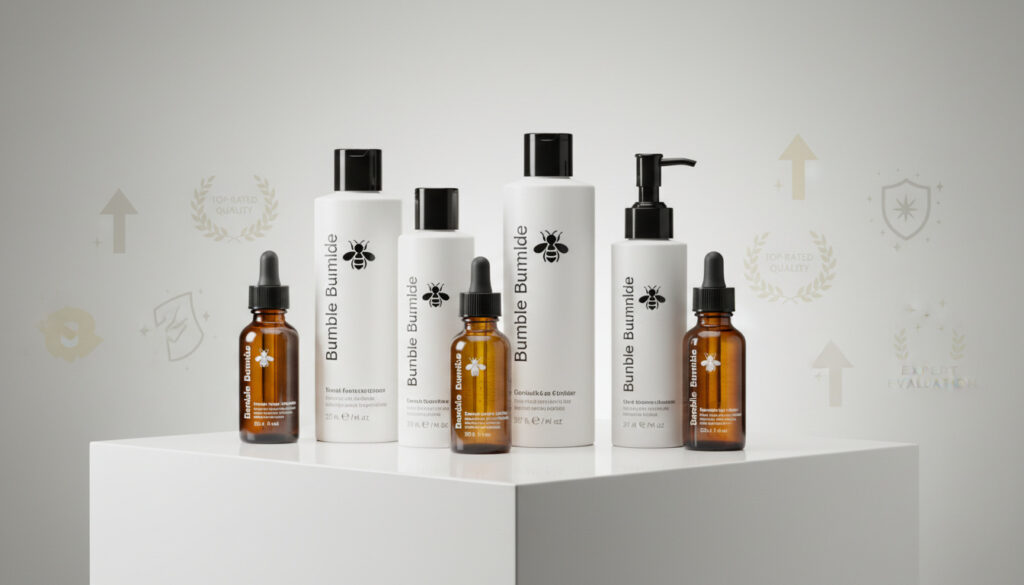
Bumble and Bumble – De Beste Hårpleieproduktene Testet
The Editorial Heritage of Bumble and bumble
When Michael Gordon opened the first Bumble and bumble salon on 56th Street in 1977, Manhattan’s hair culture revolved around rigid styling and chemical permanents. Gordon envisioned something different: a space where session stylists could experiment with texture and movement without the constraints of traditional salon expectations. This philosophy transformed Bumble and bumble from a single Manhattan storefront into a professional product empire revered for its approach to volume, surf-inspired textures, and editorial versatility.
At a Glance
Founded: 1977, New York City
Founder: Michael Gordon
Parent Company: Estée Lauder Companies (acquired 2006)
Flagship Innovation: Surf Spray (2001)
Professional Focus: Texture, volume, and heat protection
Distribution: Professional salons, specialty retailers, direct-to-consumer
Market Position and Industry Impact
Unlike mass-market competitors, Bumble and bumble maintained its credibility by refusing to dilute its professional DNA. While skjønnhetsmarkedet increasingly shifts toward influencer-driven trends, the brand anchors its marketing in editorial photography and backstage credibility. Stylists at Fashion Weeks consistently cite the Thickening line and Hairdresser’s Invisible Oil as non-negotiable kit staples, demonstrating the company’s sustained relevance in high-pressure creative environments.
The 2006 acquisition by Estée Lauder Companies provided global distribution infrastructure while reportedly preserving the autonomous product development process that defines the brand’s experimental edge. This balance between corporate resources and boutique creativity remains rare in the contemporary hair care landscape.
Core Product Lines Comparison
| Product Line | Primary Function | Key Technology | Target Hair Type |
|---|---|---|---|
| Thickening | Volume and density | Emblica Officinalis Fruit Extract | Fine to medium |
| Surf | Texture and matte finish | Salt crystals + sea botanicals | All types, especially straight |
| Hairdresser’s Invisible Oil | Heat protection and smoothing | Six-oil blend (coconut, argan, macadamia) | Dry, coarse, or color-treated |
| Sumotech | Flexible matte molding | Micro-fiber technology | Short to medium lengths |
Formulation Philosophy
Bumble and bumble’s product development diverges from the moisturizing-heavy approach dominating drugstore aisles. The brand prioritizes polymers and film-formers that alter hair’s structural behavior rather than simply coating it in silicone. Surf Spray, the brand’s breakthrough 2001 release, utilized salt and seaweed extracts to mimic the matte, wind-whipped texture achieved after ocean swimming—without the actual salt damage.
Recent reformulations address evolving consumer expectations regarding sustainability. The Hairdresser’s Invisible Oil range transitioned to sulfate-free surfactant systems while maintaining the heat protection levels required by professional stylists working with high-temperature tools. This technical balancing act—preserving performance while removing potentially stripping ingredients—reflects the brand’s laboratory priorities.
Evolution of a Texture-Focused Empire
- 1977: First salon opens at 415 West 56th Street, emphasizing cuts over chemical services
- 1997: Launch of Bumble and bumble University, offering advanced stylist education
- 2001: Surf Spray debuts, establishing the “beach hair” category in prestige beauty
- 2006: Estée Lauder Companies acquires majority stake
- 2015: Thickening line reformulated with new polymer technology
- 2019: Launch of Bond Building Repair line, entering the damage-repair space
- 2023: Refillable packaging pilot programs introduced in select North American markets
Clarifying Common Misconceptions
Consumers frequently confuse the Surf line’s salt content with drying sulfates, though the formulation relies on magnesium sulfate rather than sodium lauryl sulfate. The brand’s cleansing category also generates questions regarding the “gentle” moniker—while certain shampoos skip SLS, they maintain strong surfactant activity to remove heavy styling product buildup, particularly the waxes and oils prevalent in texturizing products.
Color-treated hair compatibility varies by line. While Hairdresser’s Invisible Oil explicitly targets chemical-treated hair with UV filters, the original Sumo wax line contains ingredients that may strip toners or deposit color unevenly on porous bleached hair.
Strategic Analysis
Bumble and bumble occupies a unique commercial position bridging prestige retail and professional backbar usage. Unlike pure-play professional brands, it maintains bransjeintervjuer visibility through Sephora and Space NK positioning, yet requires professional authentication to access the full product range. This hybrid model creates exclusivity while ensuring commercial volume.
The brand faces increasing pressure from “clean” competitors emphasizing naturally derived ingredients over synthetic polymers. However, Bumble and bumble’s continued reliance on laboratory-developed film-formers provides styling longevity that purely botanical formulas struggle to match. Whether this technical advantage outweighs shifting consumer preference toward “clean” beauty remains the central question for the label’s next decade.
Voices from the Industry
“The Thickening Dryspun Texture Spray changed how we approach backstage volume. It creates grit without the powdery residue that photograph poorly under flash.”
— Lead Stylist, London Fashion Week
“Michael Gordon taught us that hair should move like fabric. That philosophy still separates Bumble from brands that treat hair like a static sculpture.”
— Editorial Hairstylist, New York
Synthesis
Bumble and bumble’s trajectory from downtown salon to global brand illustrates the commercial viability of professional authenticity. By maintaining its education arm—including the network of styling workshops—and restricting certain formulations to salon professionals, the company preserves the technical credibility that drove its initial success. For consumers, the product range offers solutions designed by people who manipulate hair daily under demanding conditions, resulting in formulations that prioritize function over fragrance-forward marketing.
Frequently Asked Questions
Does Bumble and bumble test on animals?
The brand does not test finished products on animals, aligning with Estée Lauder Companies’ corporate policies and EU regulations. However, they maintain markets in mainland China where pre-market animal testing requirements have historically applied to certain imported cosmetics, though recent regulatory changes have modified these requirements for general cosmetics.
Which Bumble and bumble product works best for fine, oily hair?
The Pret-a-Powder line utilizes tapioca starch and zeolite rather than talc, absorbing oil without the heavy residue that weighs down fine textures. For styling, the Thickening line’s pre-styling spray provides volume without the oils present in the Hairdresser’s Invisible Oil range.
Are Bumble and bumble products safe for color-treated hair?
Specific lines like Hairdresser’s Invisible Oil and Color Minded incorporate UV filters and antioxidant complexes designed to prevent color oxidation. However, surfactant-heavy cleansers like the Sunday Shampoo, excellent for product buildup removal, may accelerate color fading in vivid or red tones and should be used sparingly on fresh color.
How does Surf Spray differ from sea salt?
Unlike pure sodium chloride, which aggressively dehydrates hair cuticles, Surf Spray combines magnesium sulfate with algae extracts and conditioning agents. This creates the matte, tactile texture of ocean-dried hair while maintaining enough flexibility to prevent the brittleness associated with actual salt exposure.
Flere relaterte innlegg
 Nicole Brown Simpson – Liv, drap og rettssaken som rystet USA
 Tom Eddie Brudvik: Skuespiller – Familie, Karriere, Alder
 Lena Kri tin Elling en: biografi, filmer og familie
 Yummy Time Bryne: Meny, levering og lokasjoner i Rogaland
 Time and Date: Free Tools for Accurate Clocks
 Emma Gunnarsen – alder, kjæreste og søsken til Marcus og Martinus
 FC Barcelona vs Osasuna: Cancellation, Messi Debt, and Comparison
 SpareBank 1 kundeservice – telefon, åpningstider og kontakt